Solar Savings Calculator: How Much Can I Save with Solar Panels and Current Incentives?
Key Takeaways
- Federal tax credits currently allow homeowners to deduct thirty percent of installation costs
- Solar savings calculators help estimate the exact timeline for a full return on investment
- Local California incentives and net metering programs can significantly increase annual utility savings
- Choosing between leasing and buying impacts long term equity and total financial benefits
Utility rates across the nation, particularly in California, continue to climb at an unprecedented rate. For many homeowners, the monthly electric bill has transformed from a standard expense into a significant financial burden. Transitioning to renewable energy is no longer just an environmental choice; it is a strategic move to secure long-term financial stability.
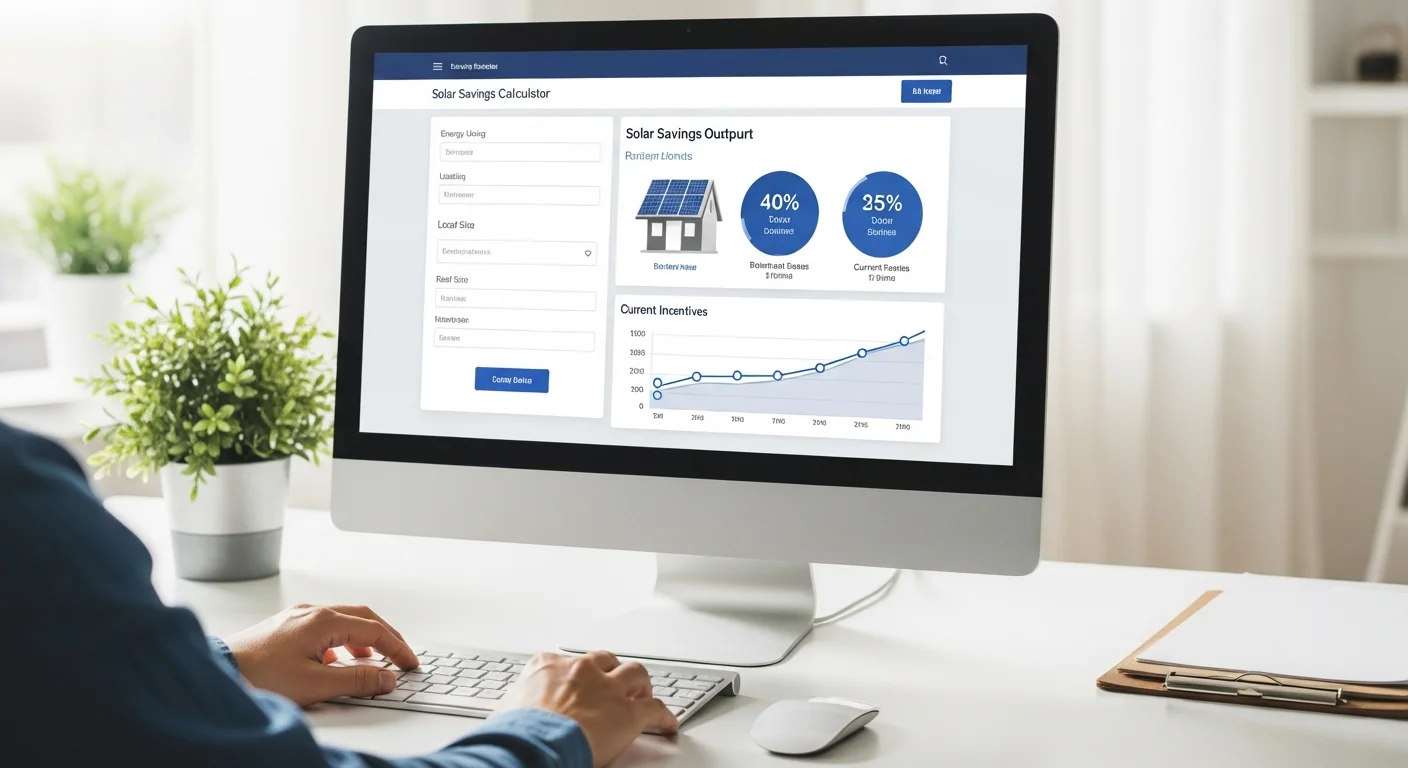
Using a solar savings calculator allows you to cut through the marketing noise and see the hard numbers. By inputting your current energy usage and local utility rates, you can generate a realistic projection of your future savings. This data-driven approach ensures you make an informed decision based on your specific roof layout and energy needs.
Ready to see your potential savings?
Access the Solar Savings Calculator →Understanding Solar Panel Incentives 2024
Solar Savings Calculator
Buy NowThe Federal Investment Tax Credit (ITC)
The single most significant driver of solar affordability is the federal tax credit. According to the U.S. Department of Energy federal tax credit guide, homeowners can currently claim a 30% credit on the total cost of their solar system. This applies to both the equipment and the labor for installation.
State-Specific Rebates and Programs
Beyond federal help, California offers unique programs to encourage adoption. While the transition to NEM 3.0 changed the landscape of net metering, there are still substantial California solar incentives for residential properties that prioritize battery storage integration. These programs are designed to help the grid handle peak demand while rewarding homeowners for their contribution.
Property Tax Exemptions
Many people worry that adding solar will spike their property taxes. However, many states provide property tax exemptions for solar installations, meaning the added value of the panels won't increase your tax liability. This allows you to increase home equity without the recurring cost of higher taxes.
How Much Can I Save With Solar Panels?
Measuring Your Energy Offset
The amount you save depends heavily on your energy offset. If your system produces 100% of the electricity you consume, you effectively eliminate your supply charges. A best solar calculator for home savings will look at your historical kilowatt-hour usage to determine the ideal system size for your roof.
Impact of Local Utility Rates
Savings are relative to what you would have paid otherwise. As companies like Southern California Edison (SCE) increase their rates, the value of every kilowatt your panels produce goes up. According to data from the California Public Utilities Commission electric rate reports, consistent annual rate hikes make solar an increasingly powerful hedge against inflation.
Estimating Lifetime Savings
Most solar panels are warrantied for 25 years. When you calculate the cumulative cost of utility power over two and a half decades versus a one-time solar investment, the savings often reach six figures. This long-term perspective is vital for understanding the true value of the technology.
Don't guess your potential savings. Get an expert calculation.
Use the OC Home Savings Tool →Solar Panel ROI for Homeowners
The Payback Period Explained
The solar panel ROI for homeowners is usually measured by the "payback period." This is the number of years it takes for the electricity savings to equal the initial cost of the system. In many parts of California, this period has dropped to between 5 and 8 years due to high electricity costs and federal tax credits.
Home Resale Value Increase
Research often shows that homes with solar installations sell for more than those without. According to studies highlighted by NREL solar value research, every $1 decrease in annual utility bills can add up to $20 in home value. This means your ROI isn't just in monthly savings, but in total asset appreciation.
| Financial Factor | Economic Impact |
|---|---|
| Federal Tax Credit (ITC) | 30% immediate reduction in net cost |
| Monthly Bill Savings | Typically $150 - $400 reduction per month |
| Property Value Increase | Average of 4% increase in home resale price |
| Maintenance Costs | Minimal; primarily occasional cleaning |
Solar Leasing vs Buying Comparisons
The Benefits of Purchasing
When you buy your system, you own the equipment and the energy it produces. This allows you to claim the federal tax credit yourself and maximize your reducing electric bills with solar strategy. Owners typically see the highest long-term ROI because they don't have a monthly lease payment.
The Reality of Solar Leasing
Leasing or using a Power Purchase Agreement (PPA) can be attractive because it often requires zero down payment. However, in solar leasing vs buying comparisons, the third-party owner usually keeps the tax incentives. Leasing is often best for those who cannot utilize tax credits but still want to lower their monthly energy costs immediately.
Maximizing Savings in Orange County
Local Sun Exposure and System Sizing
Orange County is uniquely positioned for high solar yields. The average cost of solar panels in Orange County is offset by the sheer volume of sunlight our region receives annually. This high production capability means smaller systems can often generate more power here than larger systems in the Pacific Northwest.
Working with Local Experts
Navigating local permitting and HOA requirements can be complex. Working with experts who understand the nuances of the best solar calculator for home savings specific to Southern California ensures you don't miss out on local city-level rebates or specific utility tier savings.
Stop overpaying for electricity in Orange County.
Start Your Saving Journey →Frequently Asked Questions
How accurate is a solar savings calculator?
Accuracy depends on the data provided. High-quality calculators use local weather patterns, current utility rate structures, and precise roof orientation to provide estimates that are usually within 5-10% of real-world performance.
What happens to my savings with NEM 3.0 in California?
While NEM 3.0 reduced the credit for exported energy, it significantly increased the value of home battery storage. By pairing solar with a battery, you can store your own energy for use at night, maintaining high savings levels despite the policy changes.
Do solar panels require a lot of maintenance?
No, solar panels are remarkably durable. Most systems only require an annual cleaning to remove dust and debris to ensure maximum efficiency. They have no moving parts, which leads to very low failure rates over their 25-year lifespan.
Can I still get the federal tax credit in 2024?
Yes, the federal tax credit is currently set at 30% through 2032. This was extended by the Inflation Reduction Act, providing long-term certainty for homeowners looking to go solar.
Is my roof right for solar?
Ideally, you want a south-facing roof with little to no shade from trees or nearby buildings. However, east and west-facing roofs are also very productive in California. A professional assessment can determine your specific roof's solar potential.
Take Control of Your Energy Future
The transition to solar energy is one of the few home improvements that pays for itself multiple times over. By utilizing a solar savings calculator, you can move away from estimations and toward a concrete financial plan. With the 30% federal tax credit and the high cost of grid power, the economic argument for solar has never been stronger.
Remember that the best time to go solar was yesterday, but the second best time is today. As utility rates continue to rise, every month you wait is a month of missed savings. Take the first step by calculating your potential and seeing how renewable energy can work for your household budget.
About the Author

Written by William Corcoran, Orange County Home Savings Expert
William Corcoran has helped Orange County families save money on their homes for over 15 years. Specializing in property tax reduction and smart refinancing, he offers expert guidance you can trust. www.energybot.com www.energystar.gov
Related Articles


Ready to Find Your Savings?
Get a free personalized report showing all rebates and incentives your home qualifies for.
Get My Free Report