Solar Savings Calculator: How Much Can I Save with Solar and California Incentives?
Key Takeaways
- Calculate your personalized return on investment using specific local utility data
- The federal solar tax credit currently covers thirty percent of total installation costs
- California residents can significantly offset high utility rates with net energy metering
- Modern solar systems often pay for themselves within five to seven years in Orange County
Homeowners across Orange County are facing a significant challenge: skyrocketing utility rates that show no signs of slowing down. As traditional energy costs continue to climb, many are turning to the sun to reclaim control over their monthly budgets. However, moving to renewable energy can feel overwhelming without the right data.
By utilizing a solar savings calculator, you can strip away the guesswork and see exactly how much you can save with solar. These tools analyze your current consumption against local weather patterns and available incentives to provide a clear financial roadmap. It is the first step in determining if your roof is a goldmine for energy production.
Why Use a Solar Savings Calculator?
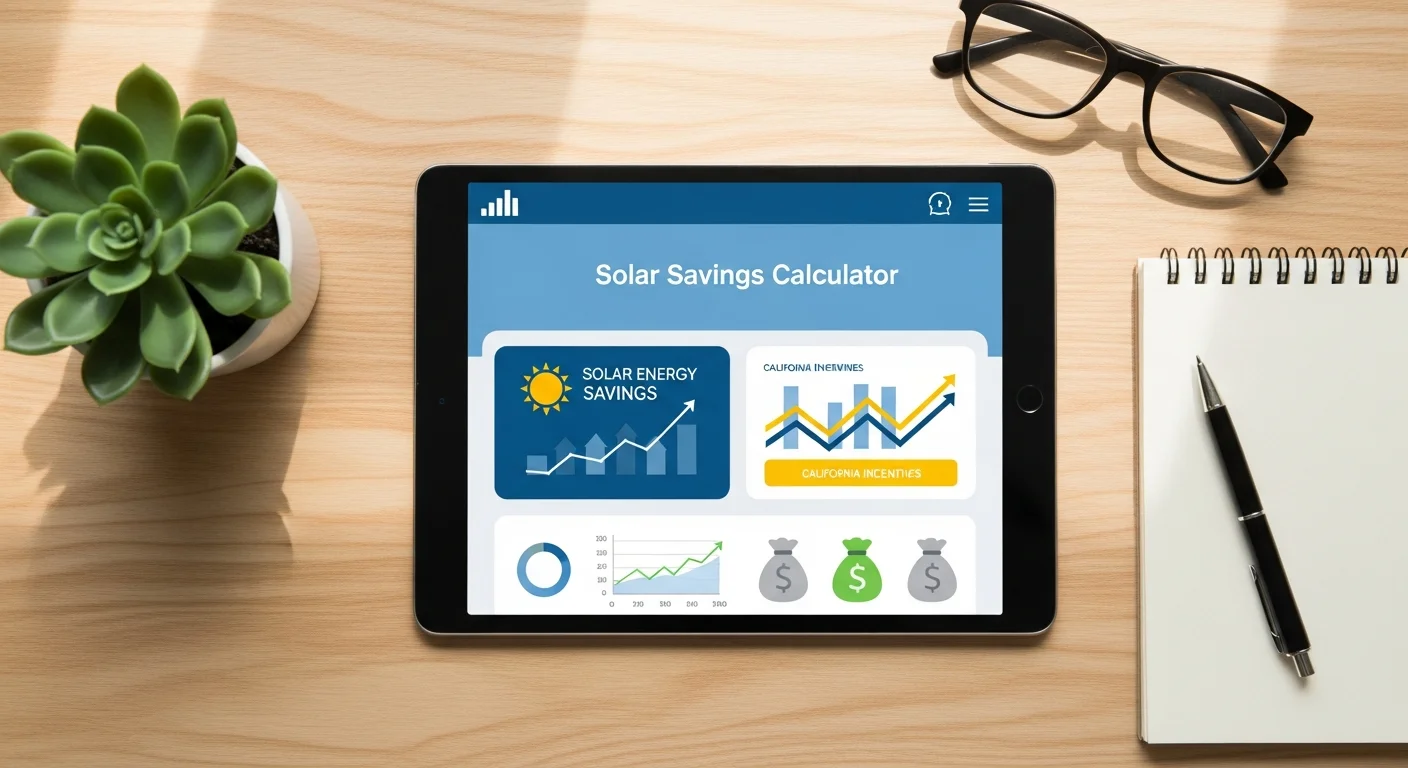
Solar Savings Calculator
Buy NowPersonalized Energy Analysis
Generic estimates often fail to account for the unique architecture of your home. To calculate solar savings Orange County residents need a tool that looks at roof tilt, shading from nearby trees, and local utility rate structures. A digital calculator provides a bespoke report that reflects your actual potential.
Financial Planning and ROI
Investing in solar is a financial decision as much as an environmental one. According to the Department of Energy guide to solar investment, understanding your payback period is crucial for long-term satisfaction. The calculator helps visualize when your system will pay for itself.
Ready to see your potential savings? Try our free tool today!
Calculate Your Solar Savings Now →Understanding California Solar Panel Incentives
The Federal Investment Tax Credit (ITC)
The solar panel federal tax credit advantages are more substantial than ever under the Inflation Reduction Act. This allows you to deduct 30% of the cost of installing a solar energy system from your federal taxes. This is a direct credit, not just a deduction, meaning it provides dollar-for-dollar value.
State-Specific Programs
Leveraging California solar panel incentives involves navigating programs like the Self-Generation Incentive Program (SGIP). According to research published by California Public Utilities Commission (CPUC), these state-backed programs can provide additional rebates for battery storage solutions alongside your solar panels.
Solar Panel Costs vs Savings: The Long-Term Outlook
Initial Investment vs Utility Offsets
When analyzing solar panel costs vs savings, it is vital to look beyond the sticker price. While the upfront cost can be significant, the monthly savings on electric bills often total tens of thousands of dollars over the 25-year lifespan of the panels. Most homeowners find that the break-even point occurs much faster than they anticipated.
Maintenance and Longevity
Modern solar systems require very little maintenance, which preserves your savings over time. According to Wikipedia data on solar panel efficiency, Tier 1 panels retain over 80% of their power output even after two decades of service, ensuring consistent energy production.
Stop paying high utility rates and start owning your power.
Get Your Custom Savings Quote →Addressing High Electricity Bills in California
Rising Costs of the Grid
Dealing with high electricity bills in California has become a standard burden for residents. Utility companies frequently request rate hikes to cover infrastructure upgrades and wildfire mitigation. Solar provides a fixed-cost alternative that insulates you from these unpredictable increases.
Increased Property Value
One of the major solar energy benefits for home value is the premium buyers are willing to pay for energy-efficient properties. Research from the National Renewable Energy Laboratory (NREL) suggests that solar panels can increase a home’s value by $20 for every $1 reduction in annual utility bills.
Solar vs Grid Power Costs: Making the Switch
| Feature | Traditional Grid Power | Residential Solar Power |
|---|---|---|
| Monthly Cost | Increases annually (approx 5-7%) | Locked in or zeroed out |
| Tax Benefits | None | 30% Federal ITC |
| Home Equity | No change | Significant increase |
Ownership vs Utility Dependency
In the debate of solar vs grid power costs, ownership is the key. When you pay a utility bill, that money is gone forever. When you pay for solar, you are building equity in an asset that eventually provides free electricity.
Financing Options
Understanding leasing vs buying solar panels is essential for your financial strategy. Buying allows you to claim the federal tax credit, while leasing often requires no upfront cost but limits your long-term ROI. A calculator can help compare these two paths side-by-side.
Orange County Solar Rebates and NEM 3.0
The Shift to NEM 3.0
To get net energy metering explained simply: it is the system where you sell excess power back to the grid. California recently transitioned to NEM 3.0, which prioritizes battery storage. Homeowners who combine solar with batteries can still achieve massive savings by storing energy for use during peak evening hours.
Local Incentive Stacking
Searching for Orange County solar rebates can reveal municipal-level incentives that vary by city. According to SEIA California solar policy data, stacking these local perks with federal credits is the most effective way to lower your net installation cost.
Frequently Asked Questions
How much can I save with solar in Orange County?
Most Orange County homeowners save between $1,500 and $3,000 annually on electricity costs. Over 25 years, this can equate to more than $60,000 in total savings, depending on your energy usage and system size.
Is solar worth it in 2024 with the new NEM 3.0 rules?
Yes, solar remains a highly profitable investment, especially when paired with battery storage. While the export rates have changed, the cost of grid power continues to rise, making self-generation a smart financial move.
What is the best solar calculator for homeowners?
The best calculators use real-time local utility rates and localized weather data. Our tool at Orange County Home Savings is specifically calibrated for the Southern California market to provide the highest accuracy.
Does the federal tax credit apply to battery storage?
Yes, under current regulations, standalone battery storage or batteries installed with solar are eligible for the 30% federal investment tax credit. This makes it significantly more affordable to add backup power to your home.
How long does it take for solar panels to pay for themselves?
In California, the typical payback period ranges from 5 to 8 years. Considering the panels are warrantied for 25 years, this leaves you with nearly two decades of essentially free electricity.
Ultimately, the decision to go solar is about securing your financial future. As grid prices fluctuate, having a fixed cost for your energy provides peace of mind that few other home improvements can offer. The technology is proven, the incentives are available, and the sun is always shining in Orange County.
Don't let another month of high utility bills drain your bank account. Use a data-driven approach to understand your options and choose a system that meets your family's needs for years to come.
Calculate your savings and take control of your energy future.
Access the Solar Savings Calculator Now →About the Author

Written by William Corcoran, Orange County Home Savings Expert
William Corcoran has helped Orange County families save money on their homes for over 15 years. Specializing in property tax reduction and smart refinancing, he offers expert guidance you can trust. www.energybot.com www.energystar.gov
Related Articles


Ready to Find Your Savings?
Get a free personalized report showing all rebates and incentives your home qualifies for.
Get My Free Report