Accurately Measuring Your Swimming Pool Capacity for Peak Efficiency in 2026
Key Takeaways
- Accurate measurement prevents chemical waste and saves money on utility bills
- Formulas for volume vary based on the specific geometric shape of your pool
- Proper sizing of your variable speed pump relies on correct gallonage calculations
- Heating efficiency in 2026 is maximized when the heater matches the pool capacity
As we enter the Spring 2026 season, homeowners in Orange County are looking for ways to cut utility bills and improve sustainability. Whether you are upgrading your equipment or balancing your spring chemistry, it is essential to determine pool volume correctly. An incorrect estimate can lead to over-treating with chemicals or running your pump longer than necessary, wasting hundreds of dollars annually.
Proper water management is no longer just about clarity; it is about efficiency. In 2026, modern filtration systems and variable speed pumps require precise data to operate within their most efficient power bands. By taking the time to measure your pool accurately, you empower yourself with the data needed to utilize high-tech savings tools.
Why Pool Capacity Knowledge is Crucial for 2026 Homeowners
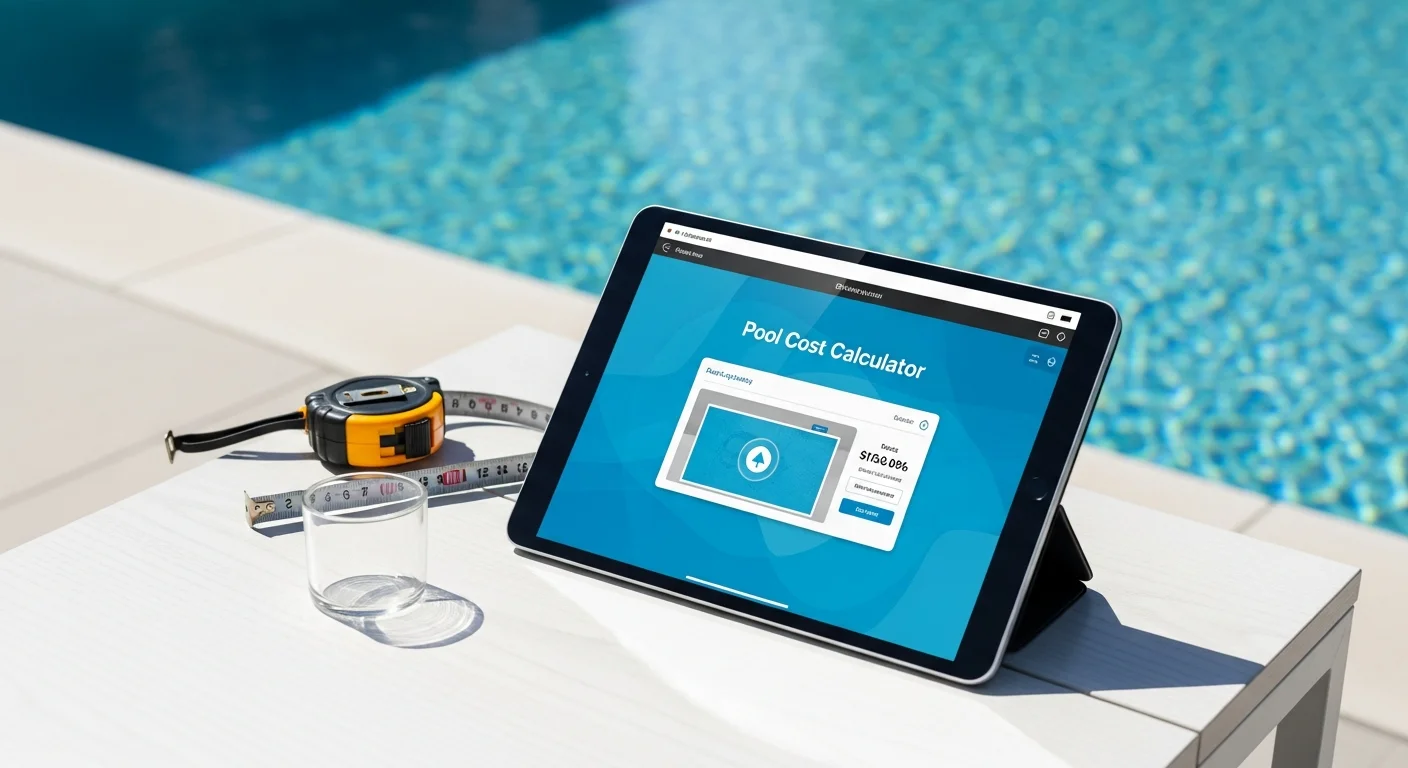
Pool Cost Calculator
Buy NowChemical Precision and Safety
According to the Centers for Disease Control and Prevention, maintaining a proper chemical balance is vital for swimmer safety. When you know your exact gallonage, you can apply the perfect dose of chlorine or algaecide, preventing skin irritation and cloudiness.
Energy Cost Reductions
Energy prices in 2026 continue to fluctuate, making efficiency a priority. Sizing a pump to a pool that is smaller than you think results in wasted electricity, while an undersized pump on a large pool leads to poor sanitation and stagnant water.
Equipment Longevity
Pool heaters and filters have specific flow rate requirements. Understanding your water volume ensures that these expensive components are not overworked, extending their lifespan and reducing the need for costly Spring 2026 repairs.
How to Determine Pool Volume for Any Shape
To determine pool volume for a standard rectangular pool, you must first find the average depth. This is calculated by adding the depth of the shallow end to the depth of the deep end and dividing by two. Once you have this figure, use the following formula: Length x Width x Average Depth x 7.5.
The multiplier of 7.5 is used because there are approximately 7.5 gallons of water in every cubic foot. If your pool has a consistent slope, this calculation is highly accurate. For pools with multiple levels or complex shelf systems, it is best to break the pool into sections and calculate each one individually before adding them together.
Ready to see how much you can save on your monthly utility bills?
Use Our Free Pool Calculator →Essential Formulas for Circular and Oval Pools
Round Pool Calculations
For a circular pool, the math changes slightly. You will need to square the diameter, multiply by the average depth, and then multiply by 5.9. This constant (5.9) accounts for the curvature of the walls compared to a square container.
Oval and Kidney Shapes
Oval pools use a formula of Long Diameter x Short Diameter x Average Depth x 5.9. For kidney-shaped pools, measure the widest point of both the large and small bulbs, then use the average of those two widths in a standard rectangular formula, though results may vary by 10-15%.
Accuracy for 2026 Trends
Modern 2026 pool designs often include tanning ledges and "beach entries." When you determine pool volume for these custom features, subtract the volume of the displaced water from the total to avoid overestimating your chemical needs.
The Relationship Between Water Volume and Pump Selection
According to the U.S. Department of Energy, pool pumps are one of the largest electricity consumers in the home. In 2026, the shift toward variable speed pumps (VSPs) has made volume calculation even more critical.
| System Feature | Efficiency Benefit |
|---|---|
| Variable Speed Pump | Saves up to 80% on energy by running at lower speeds for longer durations. |
| Correct Volume Data | Allows for the minimum required turnover rate, preventing over-pumping. |
| Smart Controllers | Automates filtration based on real-time water needs and utility off-peak hours. |
Want to optimize your pool pump run time for Spring 2026?
Calculate Your Potential Savings →How Proper Sizing Impacts Your Heating Bill
The Physics of Heat Transfer
Heating a pool requires a specific amount of British Thermal Units (BTUs) based on the mass of the water. If you underestimate your volume, you may purchase a heater that is too small, forcing it to run continuously and significantly increasing your gas or electric bill this Spring 2026.
Heat Pumps vs. Gas Heaters
As noted by the Pool & Hot Tub Alliance, heat pumps are incredibly efficient but take longer to raise temperatures. Knowing your volume allows you to calculate exactly how many hours it will take to reach your desired temperature, preventing unpleasant surprises.
Frequently Asked Questions
How do I calculate average depth if the floor is uneven?
Measure the depth at the shallowest point and the deepest point, then add them together and divide by two. If there is a large flat section, you may want to take a third measurement in the middle to get a more accurate average.
Why is the 7.5 multiplier used in pool formulas?
This number represents the approximate number of gallons in one cubic foot of space. It is a standard constant used in the industry to convert volume into a liquid measurement of gallons.
Should I include the volume of my spa?
If your spa spills over into the pool and shares the same filtration system, you should include it in your total volume. Most standard attached spas hold between 400 and 600 gallons of water.
Does pool volume change over time?
The physical volume of the vessel does not change unless you perform major renovations. However, your water level can fluctuate due to evaporation or heavy rainfall, which slightly alters the active volume being filtered.
What is the turnover rate and why does it matter?
Turnover rate is the time it takes for all the water in the pool to pass through the filter once. Most health guidelines suggest a 6 to 8-hour turnover rate, which is why knowing your total gallons is essential for setting your pump timer.
In conclusion, taking the time to determine pool volume is the single most effective step you can take toward a lower-maintenance and more affordable backyard experience. As technology advances in 2026, the value of having precise data only grows.
Don't guess when it comes to your home's energy consumption. Use professional resources and tools to ensure your pool remains a source of joy rather than a drain on your finances. With the right data, you can enjoy a crystal-clear pool all through Spring 2026 and beyond.
Ready to maximize your efficiency? Use our professional-grade tool today.
Get Your Custom Savings Report →About the Author

Written by William Corcoran, Orange County Home Savings Expert
William Corcoran has helped Orange County families save money on their homes for over 15 years. Specializing in property tax reduction and smart refinancing, he offers expert guidance you can trust. www.energybot.com www.energystar.gov
Related Articles
Ready to Find Your Savings?
Get a free personalized report showing all rebates and incentives your home qualifies for.
Get My Free Report